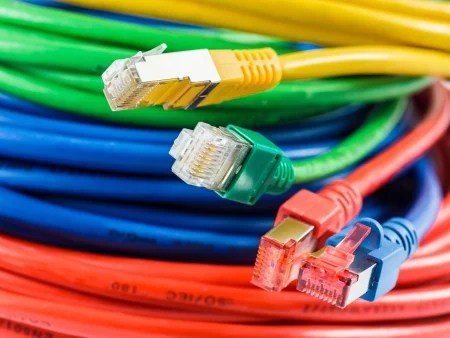
We all know that Ethernet has become the way to connect things to the internet and computers to each other. While we used to use wire and BNCs to connect things to the internet, we now use Ethernet to do this. Ethernet cables are used to transmit data from one place to another and you can use different kinds of Ethernet cables to suit your needs. A blog about the different kinds of Ethernet cables and what their uses are.
There are a few differences between Cat5e and Cat6 cables. Cat5e cable uses 4 pairs of wires to transmit data, while Cat6 cable uses 8 pairs of wires. Cat6 cable has better performance when it comes to resistance to interference and distance. Cat5e Cable 1000ft is perfect for all applications, where interference is minimal, and distance is usually less than 100m. Bulk Cat6 cable is appropriate for all applications, where interference can be present and distances are usually longer.
What is Cat5e Cable
Cat5e is a type of cable used to run ethernet and other network connections. Cat5e cable is an upgraded version of Cat5. The ‘e’ at the end of the name refers to ‘enhanced’. While the cables are not backward-compatible with Cat5, they do have faster data transfer speeds, better noise rejection, and improved performance over longer distances.
What is Cat6 Cable
Cat6 is the latest cable standard designed to transmit internet, voice, video, and data with more security than its predecessor, the Cat5e cable. It is a high-speed UTP (Unshielded Twisted Pair) cable designed to deliver more bandwidth than the common Cat5 cable.
In order to meet the requirements of the 10-Gigabit Ethernet standard, the Cat6 standard was developed. Compared to the previous generation, Cat6 cable has more stringent performance requirements, due to the fact that it is used both in professional and residential networks. As a matter of fact, it is the most commonly used network cable for Ethernet networks (10BASE-T, 100BASE-T, 1000BASE-T, 10GBASE-T). The Cat6 cable is primarily used on the Ethernet 1000BASE-T standard, operating at a frequency of up to 250 MHz or a maximum of 500 MHz.
Performance
CAT5e cables are less expensive than CAT6 cables, but they do not offer the same level of performance. Here are some key differences:
- CAT6 cables can support higher speeds and more data transfer rates than CAT5e cables.
- CAT6 cables are stronger and can support heavier loads than CAT5e cables.
- If you need to upgrade your network infrastructure, choosing a Bulk Cat6 Cable is the best option because it will provide better performance and reliability.
How do you Choose the Right Cable?
Before buying the cable you need to consider a few things. How much is the cable going to be used? Will it be within the house, or will it be on a construction site and need extra protection? Is it going to be used with small devices like cell phones, or with big devices, like a large computer? A computer cable that’s too small won’t work as well as a cable that’s thicker, so you’ll want to make sure you get the right size.
 Network Cables